Report: Apple Already Preparing to Release iOS 8.0.1 Bug-Fix Update

| |

Report: Apple Already Preparing to Release iOS 8.0.1 Bug-Fix Update
Apple has already cooked up a fix for certain problems discovered in iOS 8, according to blog site MacRumors.
Citing an anonymous source, MacRumors said Tuesday that an iOS 8.0.1 update addresses several key bugs, including problems with the following:
  • call forwarding and freezing when opening Visual Voicemail
  • keypad not showing up to enter iCloud Keychain verification codes
  • videos sometimes not playing on Safari
  • AirDrop support for Passbook passes
  • installation of VPN profiles
Apple released iOS 8 last Wednesday with several new features and refinements. But it didn’t take long for some iOS users to start reporting problems. Conversations on Apple’s support forums and other online sources have pointed to WiFi connectivity glitches, the usual battery drain issue, and slow performance in Safari, among other problems.
The update will likely patch other bugs beyond those cited above, according to MacRumors. So some of the issues reported on the support forums may be resolved as well.
Apple had apparently been readying iOS 8.0.1 even before it launched iOS 8, as the update has already been sent to mobile carrier partners for testing, MacRumors added. No release date has yet been revealed. But if the update is at the carrier stage, then the actual user rollout shouldn’t take too much longer to kick off.
Last year, Apple rolled out iOS 7.0.1 just a few days after it launched iOS 7 in order to fix a fingerprint glitch with the iPhone 5s. Less than a week after that, iOS 7.0.2 came out to patch a bug with the lock screen.
CNET contacted Apple for comment and will update the story with any further details.
أكمل القراءة Résuméabuiyad

PlayStation TV Coming to U.S. in October at $99 Price

| |
PlayStation TV Coming to U.S. in October at $99 Price
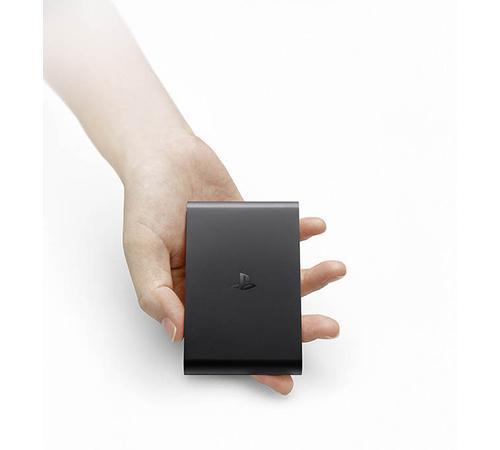
Available in Japan since last year, the PlayStation TV will go on sale in the U.S. this Oct. 14 for $99.99, Sony announced. The set-top box is due to launch in Europe one month later with a price tag of €99.99.
When connected to a television, PlayStation TV provides access to a selection of PS Vita, PSP, and PS One games, in addition to allowing users to access saved movies, TV shows, and music like any other set-top box.
The system also allows PlayStation 3 and 4 players to pick up a saved game on a different screen thanks to its Remote Play feature.
Aside from the around 700 games available through the service (including God of War, Tomb Raider, and Tekken), three PS Vita games will be provided for free with purchase (Worms Revolution Extreme, Velocity Ultra and OlliOlli).
PlayStation TV has an internal storage capacity of 1 GB (expandable via memory card) and is compatible with the DualShock 3 and DualShock 4 controllers.
In the US, the device will be available in a bundle including a DualShock 3 controller, an 8 GB memory card and The Lego Movie Videogame for $139.99. No bundled offers have been announced so far for the European market.
أكمل القراءة Résuméabuiyad

Phablet Reviews Before and After iPhone 6 Plus (Everyone Got It Wrong)

| |
Bigger is better. No, wait, bigger is worse. Well, which is it?
Apple’s newly supersized 4.7-inch iPhone 6 and the jumbo, 5.5-inch iPhone 6 Plus are a marked departure for the company, which has clung to the same, small screen size for years. It has gone so far as to publicly deride larger phones from competitors, notably Samsung, even as their sales grew to record highs.
Tech reviewers over the years have tended to side with Apple, in general saddling reviews of the Samsung Galaxy Note – a 5.3-inch device that kicked off the phablet push in 2012 – with asides about how big the darn thing was. To be fair, I’m one of them; I called the 6.3-inch Galaxy Mega “preposterous” last year. I also think the iPhone 6 Plus may be more phone than most people will be comfortable with, although the skyrocketing sales seem to point otherwise.
But does Apple have something special? Can its phones succeed where others have … well, already succeeded? And more importantly, are tech reviewers being fair when they review the iPhone 6 Plus? Here’s what some of them said today, compared with how they reviewed earlier phablets and big phones from the competition.
BGR
Jonathan Geller spun 180 degrees thanks to Apple. But he’s decent enough to admit he was wrong.
2012:  Samsung Galaxy Note
The most useless device I’ve ever seen … This is a phone, after using it for a few hours, that feels like it is too big to be taken seriously. That’s the end of it. I don’t care if you like large screens on mobile devices, I don’t care if you love Android, and I don’t care if you love 4G LTE — this is a device fit for use only by such a small subset of the human population that I can’t fathom how AT&T and Samsung are putting so much marketing resources behind it.
– Jonathan Geller
2014:  Apple iPhone 6 Plus
Now that Apple has finally taken the wraps off the iPhone 6 and the iPhone 6 Plus, and Apple fans are going crazy with anticipation over the largest iPhones ever released, something needs to be said. And that something is, “Thank you, Samsung.” We got it wrong.
– Jonathan Geller
TechCrunchTechCrunch wasn’t sure how it felt about phablets at first. But larger iPhones have clearly convinced them.
2012:  Galaxy Note
Unfortunately, you might look a little crazy with that huge thing up to your face. I found that it was really difficult to get comfortable with the device, never feeling like I had complete control over it as I would with a smaller phone. On the other hand, the mobile video experience offered by the Note can’t really be beat.
– Jordan Crook
2014:  iPhone 6 Plus
In terms of carrying and holding the device, the additional size makes for a less ‘perfect’ ergonomic quality, something the iPhone 6 definitely achieves, but there’s still lots to love about the industrial design of the 6 Plus … For most tasks, I find the iPhone 6 Plus to be a two-handed device – but I also find that I’m absolutely fine with that.
– Darrell Etherington
The Wall Street Journal / RecodeLauren Goode is singing a very different song – and is willing to admit it. So too Walt Mossberg, who called the 5.3-inch Note “gargantuan” and the 4.7-inch iPhone 6 as “terrific.”
2012:  Galaxy Note 2 It’s still too big for a smartphone … After testing it over the past week and a half, the awkwardness that came with carrying such a large, “notice me” phone outweighed the benefits of it, for me.
– Lauren Goode
2014:  iPhone 6 Plus
Maybe I’m getting old, and my eyes are getting worse. Or maybe I’m stuck in Apple’s reality-distortion field (help). But something strange happened this week. I started to like a phablet.
– Lauren Goode
2014:  Walt Mossberg on Galaxy Note and the iPhone 6
That iPhone, and its four-inch successor, the 5S, proved very popular. At first, larger, wider phones seemed weird (I even compared holding the first Samsung Note to your face to “talking into a piece of toast.”) But for many people, especially in certain countries, the iPhone’s screen began to seem too small, as competing models appeared with bigger and bigger screens. At first, larger, wider phones seemed weird … the iPhone 6’s 4.7-inch screen is a catch-up feature. But it’s very well done.
– Walt Mossberg
The New York Times / YahooFor David Pogue, a 4.8-inch Samsung was great, but so big it needed to be ridiculed. A 5.5-inch iPhone “doesn’t seem bigger than the iPhone 5,” however. He’s clearly adjusted to the scale.
2012:  Galaxy S3
This phone is huge. Its 4.8-inch screen is a broad canvas for photos, movies, maps and Web pages. But you can’t have a big screen without a big body, and this one is more VHS cassette than postage stamp. It’s the old trade-off: A big phone is better when you’re using it, but a small one is better when you’re carrying it.
– David Pogue
2014:  iPhone 6 Plus
The iPhone 6 and iPhone 6 Plus are absolutely terrific phones. They’re fast and powerful and well designed. There’s not a single component that hasn’t been improved. These phones are a delight to behold and to be held.
– David Pogue
The GuardianLooks like The Guardian had a change of heart, err hand? At least they’re not above admitting it.
2013:  Galaxy Note 3 The sheer size of the device basically makes one-handed operation impossible. Samsung’s given the Note 3 an entire settings menu dedicated to trying to make it easier to use one-handed, but even with my adult male-sized hands it’s a struggle to reach even half of the screen without dropping the device.
– Samuel Gibbs
2014:  iPhone 6 Plus
Too big. This thing’s too big. Waaay too big. It’s … actually, that screen is pretty nice, isn’t it? Wow, you really can get a lot of content on there, can’t you? Hey, my hand’s getting used to the size. It’s quite comfortable, isn’t it?
– Charles Arthur
USA Today
Ed Baig stuck to his guns: Phablets in general just aren’t going to work for everyone, regardless of who makes them.
2012:  Galaxy Note
Screen size is a balancing act, of course, and some will find the large display ungainly. Holding the phone to your ear might feel a bit dorky. I found it could easily fit in a coat pocket or purse, and surprisingly my front jeans pocket as well. But the size is simply not going to work for everybody.
– Ed Baig
2014:  iPhone 6 Plus
I prefer the 6 Plus because I like the biggest of the big screens, and like that I have to squint less often. It felt fine in my jeans pocket, but won’t fit every snug purse or small pair of hands.
– Ed Baig
CNetCNet’s reviewer said the Note was a really, really big phone, but a great one. The iPhone is a great phone but a really, really big one.
2012:  Galaxy Note
There’s no way this baby is slipping into my jeans pockets, but it’s fine for my purse … With its huge screen and throwback stylus, the Samsung Galaxy Note is a polarizing smartphone that winks at tablet territory. Those who like their screens XL will find a top-notch device that lets multimedia shine. The S Pen adds some artistic potential, but for some, the phone will just simply be too big.
– Jessica Dolcourt
2014:  iPhone 6 Plus
The iPhone 6 Plus is too big for everyone to love it, but it’s Apple’s best phone this year. If your budget and your pocket can make room for it, give the iPhone 6 Plus serious consideration.
– Tim Stevens
The VergeAt first, The Verge was obsessed with the sheer size of the Note. Today size isn’t the same factor it once was.
2012:  Galaxy Note
Human society has yet to evolve to the point where it can witness a person holding up a massive slate of technology to his ear without attempting to make a bad joke about it … It’s only the one-size-fits-none form factor and some software troubles that hold the Galaxy Note back from being a truly memorable mobile device.
– Vlad Savov
2014:  iPhone 6 Plus
The iPhone 6 Plus is a big phone because it has to be; Apple made a big phone in 2014 because consumers have demanded big phones. Samsung’s empire is built on gigantic phones that keep getting bigger … and while Apple initially derided screen size as an unworkable gimmick, it turns out that bigger sells … I’m going to buy an iPhone 6 Plus. I’m taken with it; it feels like an entirely new kind of device for Apple, and it has such a killer camera I can’t say no.
– Nilay Patel
InfoWorldGalen Gruman gets the award for consistency — and bluntest statement about the sheer size of modern phones.
2012:  Galaxy Note
The Galaxy Note’s 5.75-inch height and 3.25-inch width fit in my open palm, but without much leeway. Many women and even men won’t be so lucky. … Even two-handed operation can be problematic. In vertical orientation, thumb-typing is quite comfortable on the larger-than-usual onscreen keyboard. But in horizontal orientation, I strained to reach the innermost keys with my thumbs, despite my large hands.
– Galen Gruman
2014:  iPhone 6 Plus
The iPhone 6 Plus is too big for me.
– Galen Gruman
Digital TrendsWe can’t very well call out other publications without quoting ourselves. Here is what our Mobile Editor Jeffrey Van Camp thought of the Galaxy Note and iPhone 6 Plus.
2012:  Galaxy Note
I can’t imagine how many times a Note will be dropped because someone is trying to use it one handed … If you have big hands or often use your phone with two hands, then the Note may be a good device for you. Aside from its size, most everything else about it is solid … Samsung hasn’t made a huge mistake with the Galaxy Note.
– Jeffrey Van Camp
2014:  iPhone 6 Plus
I’ve never loved phablets. I still don’t … Of Apple’s two new models, we recommend the iPhone 6 over the iPhone 6 Plus, but compared to other (oversized) phablets, this is a fantastic offering … If you like big phones or have avoided previous iPhones because of their diminutive stature, take a fresh look at Apple.
– Jeffrey Van Camp
أكمل القراءة Résuméabuiyad

Study: iOS 8 Crashes 78% More Than iOS 7

| |
When we covered 8 big problems with iOS 8earlier this week, there was apparently a huge problem that was omitted from the list: it is still early for iOS 8 right now, of course, but so farApple’s new mobile software is far more prone to crashes than the previous release, iOS 7.1. According to a study from Crittercism, which says it analyzes data from more than 1 billion monthly active mobile users, apps crash 78% more frequently on Apple’s latest and greatest version of iOS 8 than they do on its predecessor.
Study: iOS 8 Crashes 78% More Than iOS 7
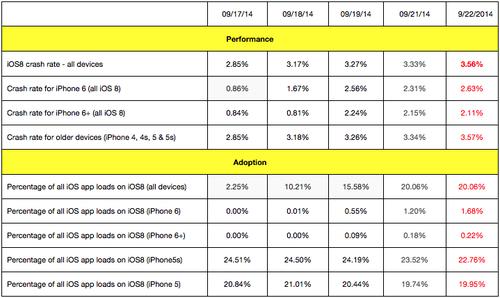
In an email to BGR, mobile application performance management experts Crittercism said that the company analyzed data across iOS users between September 17th and September 22nd, and found that app crash rates across all devices running iOS 8 landed at 3.56%.
On the same devices running iOS 7.1, apps only crashed 2% of the time, though that figure is up from 1.6% in March.
Older devices are obviously worse offenders than newer ones. As of September 22nd, apps crashed 3.57% of the time on the iPhone 5s, iPhone 5c and iPhone 4s (of note, Crittercism lumped the iPhone 4 into this group in the supplied data even though it doesn’t run iOS 8). Meanwhile, the company found that as of the same day, iPhone 6 apps crashed 2.63% of the time and iPhone 6 Plus apps crashed 2.11% of the time.
As far as adoption is concerned, Crittercism pegged iOS 8 adoption at 20.06% as of the 22nd, which is probably a bit low considering Apple confirmed a 46% iOS 8 adoption rate as of September 22nd.
More from BGR: 8 big problems with iOS 8
أكمل القراءة Résuméabuiyad

Report from Maker Faire: You, Too, Can Be a Maker

| |
Report from Maker Faire: You, Too, Can Be a Maker(Photos by Rob Pegoraro/Yahoo Tech)
Some 85,000 people paid up to $40 a ticket to get their weird on at the World Maker Faire in New York last weekend, and they could not have come away disappointed. These were among the sights at Make magazine’s celebration of do-it-yourself craftiness, computing, and kitsch at the New York Hall of Science in Queens:
• A 17-foot-tall 3D printer from SeeMeCNC named PartDaddy.
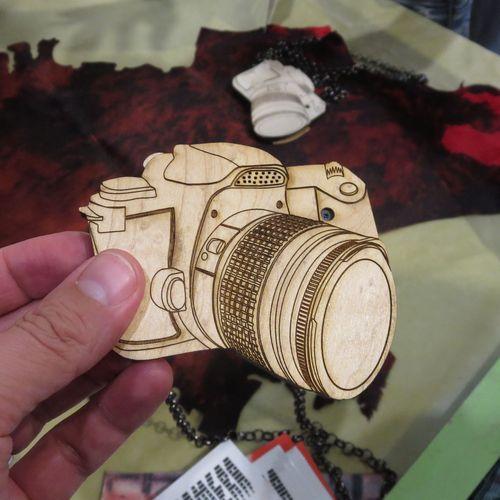
• Not-A-Camera, a laser-cut wood illustration of a camera that itself concealed a lens, circuit board, and microSD Card slot.
• The enormous robotic giraffe I last saw lumbering around the South Lawn of the White House.
• 3D-printed prosthetic hands for children developed by the e-NABLE project.
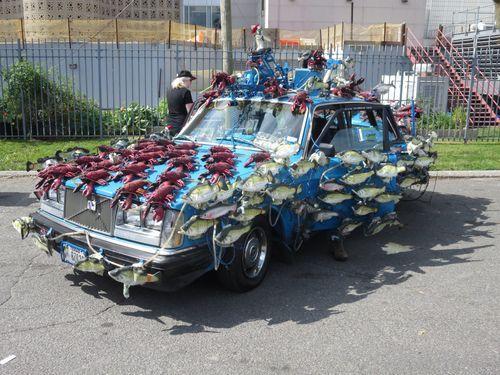
• The Sashimi Tabernacle Choir, an art car encrusted with crustaceans and fish, all of which danced and wriggled in time to such tunes as Handel’s Messiah.
• Popcade, a 50 percent scale arcade game machine that played such classics as Defender and Joust (fortunately, it did not require half-size quarters).
• A swimmable mermaid suit, made to order out of silicone. Creator Pearlie Mae offered this warning about wearing one: “It’s very exfoliating.”
As delightfully strange as all that was, it fit my expectations from visits to earlier, smaller Maker Faires. But there were other parts I didn’t see coming.
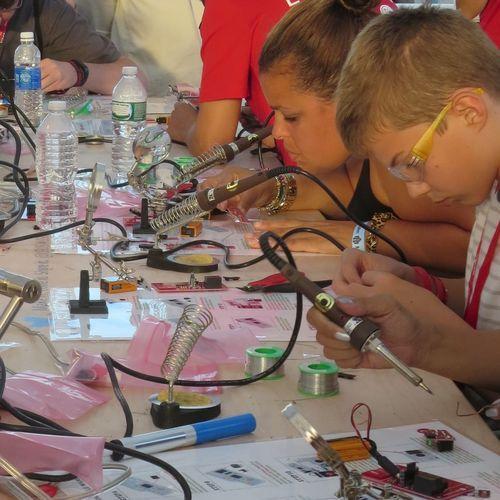
Children building circuit boards at Maker Faire
Giant companies like Maker FaireCorporations showed up in force at the World Maker Faire, the fifth in a row here: Disney, Intel, LG, Toyota, Ford, and Pepsi all had major exhibits.
And while the interest of an Intel should be obvious (at CES, it introduced a tiny computing module, Edison, made in part for the tinkering market), firms like Disney and Pepsi don’t exactly stand out as champions of DIY and remix culture.
Maker Faire founder Dale Dougherty acknowledged the potential for awkwardness during a Q&A session with the media on Sunday. “I think they’re here to learn as well,” he said. “You look at the LG booth — it doesn’t look like their CES booth.”
Indeed, the Korean electronics conglomerate had a long line of people waiting to build a tiny circuit board with a soldering iron. And Disney’s tent was mostly occupied by such guest exhibitors as littleBits, which makes tiny electronics kits for kids and other curious types; no space was given over to its movies or TV shows.
“We do our best to help them understand what the maker movement is,” Dougherty said. “Ideally, it’s a remixing of some corporate cultures with the maker movement.”
Not-A-Camera
It’s not just about 3D printing and ArduinoThe earlier, smaller Maker Faires I’d attended leaned heavily on 3D printers, tiny gadgets built around Arduino microcontrollers, interactive LED sculptures, and other projects that involve computer code, circuit boards, or both.
Here, however, I found myself spending a soothing 45 minutes getting an introduction to crocheting in the NeedleArts Zone. The analog side of Maker Faire also emerged at Bash the Trash, a project from Hastings-on-Hudson, N.Y., that makes musical instruments out of junk. For example, a thick cardboard tube, a Styrofoam box, a scrap piece of wood, some old metal wire, and a turnbuckle had become a violin of sorts.
At Pop-Up Repair, members of this New York group fixed random objects for free. While I watched, one volunteer used a soldering iron to fix a set of earrings; another wielded pliers to twist wire to patch a tear in a belt.
And a tent in a field attracted a crowd for lock-picking tutorials — not to break into other people’s homes, but to learn about how pin-tumbler locks work. As a slide show emphasized, the first rule of lock-picking is “Do not pick someone else’s locks”; the second rule is “Do not pick your locks … if you rely on them.”
At a Maker Faire, you’re more likely to be asked, “What do you make?” than “What do you do?” I was a bit leery of that question, since I don’t code and only picked up a soldering iron for the first time last month. But seeing all this non-electronic handiwork made me rethink things: Well, I do bake bread and (occasionally) brew beer, so maybe I am a maker after all.
Sashimi Tabernacle Choir
The world is going the other wayDuring that media Q&A, Dougherty spoke about the situation Maker Faire was created to work against: “Things arrive as packages; we don’t get to put them together.”
Since the first Maker Faire in 2006, many things have made life easier for the tinkerer. Open-source software, where anybody can inspect and improve a program’s instructions, is no longer a foreign concept; the cost of small-batch manufacturing with 3D printers, laser cutters, and other computerized tools has dropped dramatically; crowd-funding sites have radically opened up financing for hardware hackers.
But the mainstream gadget business keeps making products that are less open to tinkering and repair by their users. The original vision of the Macintosh — an appliance computer in a sealed case — looks more and more like the industry standard.
And I can’t really complain, since I’ve bought into this trend. The phone I used to take notes on all weekend has a battery I can’t replace and storage I can’t expand, and the laptop tucked into my bag doesn’t have a single internal component I can swap out or upgrade.
أكمل القراءة Résuméabuiyad

جميع الحقوق محفوظة ©2013